Custom Family Portrait Painting Process: From AI Reference to Fine Art

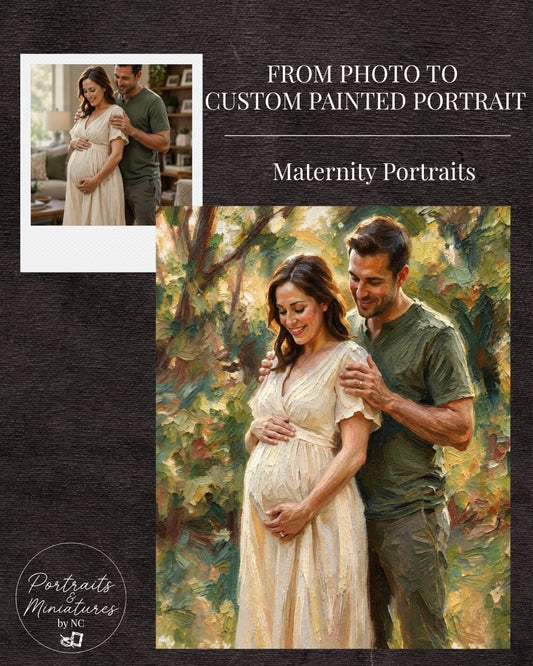
Commissioning a custom portrait is an exciting journey, and I’m thrilled to share a behind-the-scenes look at how an upcoming piece—a 18x24 inch custom family portrait for a newlywed couple—is coming to life.
Creating a truly meaningful artwork takes careful planning, especially when navigating reference photos and AI-assisted concepts. Here is how we bridge the gap between digital mockups and fine art.

The Challenge with AI-Generated Reference Images
My client sent over an AI-generated image to use as a starting point. At first glance, the image looks lovely. However, there are a few hidden pitfalls with relying solely on AI mockups for traditional paintings:
-
Resolution and Pixelation: Images downloaded from the internet often turn into a pixelated mess when enlarged. Even when scaled up to fit an 18x24 inch canvas, unoptimized digital files quickly become blotchy, blurry, and lose critical detail.
-
Missing Likeness: AI often struggles with accurate facial and physical features. In this case, my client mentioned that her husband-to-be didn't quite look like himself, and there were notable discrepancies in the pets' likenesses as well.

Refining the Composition for Canvas
Beyond resolution and likeness, there is a fundamental difference between a casual snapshot or AI concept and a well-composed painting.
-
Eliminating Distractions: Photos often contain elements that waste valuable canvas space. Rather than including unimportant background items like a portion of a window and a lamp, I prefer to focus on the subjects so they take up as much space as possible on the canvas. After all, this is a portrait of people and pets—not of household appliances and furniture.

- Spotlighting What Works: One thing the AI actually did well was the placement of their Great Dane, Lucy. After checking the actual reference photo, I noticed the scale was surprisingly accurate. I also love how the dog is leaning against the husband; even though the stance is ever so slightly wider, it works wonderfully for the overall composition.

- Correcting Pet Details: In the AI-generated version, Oscar—the second dog—was rendered too beige and brown. I worked on Oscar's coloring to ensure he truly looks like himself. Now, he too is shown leaning against his owner, capturing a tight-knit, loving family dynamic.

- Upgrading the Human Subjects: I had a different reference photo for my client initially, but after corresponding with her, I realized there was room for improvement. I switched her to a friendlier photo. The key here was making her read naturally as part of the composition. By adjusting her pose so she leans in and places a hand gently on her husband-to-be’s shoulder, the interaction feels authentic and warm.

The Power of the Golden Triangle
With these adjustments in place, we achieved a golden triangle composition for a family of four.
In classical art, the golden triangle (or pyramidal composition) is highly desired because it naturally guides the viewer's eye around the canvas in a harmonious loop, creating a strong sense of stability, unity, and balance. Every single element left in the reference design now actively enhances the narrative of the portrait, with zero visual clutter.

Next Steps
Now, it’s time to get final approval on the refined composition from my client—and then it's off to the easel for the painting stage!
Are you interested in commissioning a custom oil or acrylic portrait that captures your family's unique story? Reach out or visit our Shop to learn more about the custom portrait process.